Monday, 20 February 2012

Mary Seacole - Wonderful Woman No. 48


Mary Seacole - 1805-1881
Jamaican-British Nurse

Added to the album by a wonderful man called Owain


The truly amazing Mary Seacole... who deserved as much recognition as (Florence) Nightingale [Wonderful Woman No. 46 - http://iamawonderfulwoman.blogspot.com/2012/02/florence-nightingale-wonderful-woman-no.html], if not a whole lot more, but because she was Black, she was mostly wiped from cultural memory and the history books.
Owain


What has been most wonderful about creating this album is suggestions of women I knew nothing of before it's existence. Mary Seacole is one of those women and one I feel really pleased to have been able to learn about since Owain introduced her.

Mary was trained in basic nursing, herbal remedies and tropical medicines by her mother in her native Jamaica, where she presided over a guest house for disabled and infirm service men.

Like Florence Nightingale, on reading about the poor medical provisions for those wounded in the Crimean War, Mary felt that her skills and experience would be of benefit to the British forces. Mary travelled to London and applied to be part of the group of nurses who travelled with Florence to the war zone. Mary's application was unsuccessful, most likely because of racial prejudice, which was common place at the time.

Unperturbed, Mary travelled to the Crimea on her own funds. Once there, she approached Florence to offer her help for a second time but once again was refused. Determined that she could make a difference to the ailing soldiers, Mary stayed in the area, nursed the wounded independently and is believed to have gone into the battlefield itself in order to save the men she referred to as 'my sons'. She built a make-shift hotel on one of the main passageways for British troops. Within the hotel, Mary set up shop selling anything the average soldier might want to purchase and offered credit due to the circumstances of the patrons. Mary's establishment also offered hot, home-cooked meals and she treated any medical complaints of her guests.

The war ended abruptly and left Mary in financial ruin, with no fare to leave the area. She had many supporters in Britain, who organised fund raising events to come to her aid. These supporters included soldiers she had come into contact with, members of the Royal Family and, surprisingly given previous rejection and documented criticism of Mary's practises, Florence Nightingale anonymously donated a substantial some of money to assist in Mary's return from the Crimea.

I have witnessed her devotion and her courage ... and I trust that England will never forget one who has nursed her sick, who sought out her wounded to aid and succour them and who performed the last offices for some of her illustrious dead.
William Howard Russell, War Correspondent with The Times newspaper


In Salman Rushdie's seminal novel The Satanic Verses, Mary is mentioned as being part of the hidden figures in the history of black people. It is now widely acknowledged that, but for the colour of her skin, Mary would have been as well-known as Florence Nightingale. In recent times, her services to the British troops have been recognised, a number of institutes, schools and other organisations use her name in honourable memory.

A great addition to the album - Mary Seacole, a very wonderful woman.

The grateful words and smile which rewarded me for binding up a wound or giving a cooling drink was a pleasure worth risking life for at any time.
Mary Seacole

Friday, 17 February 2012

Dian Fossey - Wonderful Woman No. 47


Dian Fossey - 1932-1985
American Primatologist, Conservationist and Writer


Like many people, my first introduction to the life of Dian Fossey came from watching Sigourney Weaver's portrayal of her in the 1988 film biopic Gorillas in the Mist. I was so moved by the film that Dian's name has stayed with me ever since, she really was a truly remarkable woman, who lived and died by her principles.

Dian first arrived in Africa in 1963. She spent time travelling around the continent, taking in the wildlife and archaeology before eventually finding herself in Uganda. It was here, in Uganda, that she first encountered wild mountain gorillas. On returning to the United States, she published a number of articles about her time in Africa.

Dian returned to Africa and began an 18 year long study of gorillas and made important discoveries about the lives of the rare primates, including details of their social hierarchy and behaviour, vocalised communication (which she imitated and used), diet and a number of other previously unknown facts. She ingratiated herself with the gorillas and was able to form relationships with the animals. In 1970, Dian was pictured on the front cover of National Geographical Magazine, this brought her international celebrity and brought gorillas as gentle, intelligent creatures into the minds of the general public.

The more you learn about the dignity of the gorilla, the more you want to avoid people.
Dian Fossey


Whilst carrying out her study, Dian did a lot in the campaign to conserve the habitat of the mountain gorillas, she also opposed tourism in the area, as gorillas are able to contract illness from humans. A large part of Dian's lifework was defending the gorillas against illegal poachers who hunted and killed the animals as their meat is considered a delicacy and their feet and hands were turned into macabre souvenirs, their infants taken and sold. Dian organised patrols of the reserve and was pivotal in the arrest of many poachers.

In 1978, Dian's favourite gorilla, Digit was killed and mutilated. Subsequently, Dian founded an appeal in his name to raise funds for anti-poaching patrols. As deaths of gorillas Dian had formed bonds and relationships with continued, Dian's work became more focussed on the prevention of poaching than it was on scientific research. She was militant in finding and stopping poachers, employing fierce tactics such as arson, intimidation, capture and humiliation of those involved. Dian repeatedly clashed with local officials, who she felt did not take the necessary measures to protect the animals.

In 1985, in her bedroom, Dian was murdered and mutilated in a sustained attack. The murder weapon was a machete which she had previously confiscated from a poacher. She was buried alongside Digit and close to other gorillas killed by poachers.

She believed in her cause right until the end. She was passionate and determined. And she gave her life in the fight for what was right. And for that, she was really quite wonderful and someone I will have a huge respect for always.

Thursday, 16 February 2012

Florence Nightingale - Wonderful Woman No. 46


Florence Nightingale - 1820-1910
British Nurse, Teacher, Writer and Statistician


I cannot claim to have known the ins and outs of Florence Nightingale's career when I posted her picture in the album, I wanted to place her there as a representation of the nursing profession, of women who dedicate their lives to helping others. I was quite surprised when her inclusion resulted in some opposition:

Her knowledge & methods have long since been called into question and she she never really got her hands dirty...she was hundreds of miles from the battlefield.
Owain, A Wonderful Man


Having done some research following Owain's comment, it is apparent that there are some critics of Florence and how much of what I have always believed she did and how much she actually did is unclear.

What is clear about Florence, is that she was a very determined woman, who felt nursing was her calling and entered into the profession despite opposition from her parents, who felt ladies in the upper classes she not go out to work. She not only trained to be a nurse but became a teacher of junior nurses, passing on techniques and philosophies she had learned in other parts of Europe.

In 1854, the Crimean War erupted, British, French and Turkish troops in conflict with the Russians. A British newspaper printed a story reporting on how wounded British soldiers were receiving inadequate treatment and how many were dying as a result:

Are there no women willing to help the suffering soldiers in the hospitals of Scutari? Are no daughters of England ready for such a work of mercy?


Florence travelled to the Ottoman Empire with 38 female volunteers under her supervision, to provide medical treatment to wounded troops. Whether Florence herself "got her hands dirty" seems to be a matter of opinion but she was there and after the groups arrival, mortality levels decreased and it is recorded that sanitation in the hospitals was improved.

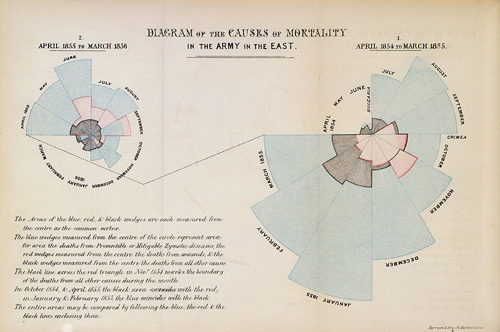
Florence founded the Nightingale Training School for nurses at St Thomas' Hospital in London and she herself spent much of her career tutoring nurses. Florence mentored Linda Richards, who is considered the U.S.A's first trained nurse, establishing formal nurses training in America. She wrote a number of books and papers on nursing, hospital standards and sanitation, hospital planning and military care for the wounded, I am led to believe that the basis of these teachings are still referenced for trainee nurses to this day. As well as writing, Florence was a gifted Mathematician and pioneered the use of statistical graphs in the nursing profession, she charted conditions and mortality in the Crimean War, used graphs to improve sanitation in British hospitals and in later life made a comprehensive statistical study of sanitation in Indian rural life.

While there are grey areas surrounding what Florence did and did not do, I feel she does deserve to be here for what she did do, for what she might have done and, mostly, for what she represents.

The very first requirement in a hospital is that it should do the sick no harm.
Florence Nightingale

Wednesday, 15 February 2012

Erykah Badu - Wonderful Woman No. 45


Erykah Badu - Born 1971
American Singer, Songwriter, Music Producer and Actress


Not enough room here for me to say how much I love this woman.
Owain, A Wonderful Man


I could not agree more with Owain's comment. Here is a woman with such talent and strength of character, it is hard to feel somewhat in ore of Erykah Badu.

If you are a regular reader of the Wonderful Women blog, you will know that music is of huge importance to me. As I have said in a previous blog, I have found it hard not to just feature recording artist after recording artist who have had an affect on me at some point in my life. Leaving Erykah out would have been impossible for me, her music has been an important part of my life for such a long time. Her lyrics are emotive and impassioned, she captures what it is to feel fierce, vulnerable, loved, heartbroken, angry, elated and so many other powerful emotions.

I was about 16 or 17 when I saw the Mama's Gun tour, when Erykah was promoting her second album... I can remember thinking what an amazing showwoman she was. She had fine timing and this great sense of drama... I feel privileged that I had the opportunity to see her live.
Amy Winehouse, Another Wonderful Woman


Known as The Queen of Neo Soul, Erykah has produced six solo albums. Her musical style is the epitome of Neo Soul, encompassing jazz, hip hop, R&B, while keeping firmly with the roots of soul. Erykah also takes inspiration from her African heritage, of which she is very proud - her name changed from Erica Wright to reflect her roots, in the belief that her given name was her slave name. She has won a plethora of awards, including four Grammys and three Soul Train Awards. Her work is widely revered and many artists have cited her as a major inspiration.

In addition to her solo career, Erykah has collaborated with some of the music industry's biggest names including Common, Jill Scott, Flying Lotus and is due to appear on the "supergroup," Rocketjuice and the Moon's debut album, to be released next month. She was also a member of the Soulquarians, along with the likes of J Dilla, Q Tip and Mos Def.

Erykah has appeared in a number of feature films, including her role as the Voodoo Queen in Blues Brothers 2000.

Aside from music, Erykah works as a Doula, offering non-medical support to expectant mothers both before and during childbirth. She plans to become a midwife. Her Twitter account often telling us how she has rushed off into the night to help bring a baby into the world.

Nothing gives me more pleasure than being the welcoming committee for a mother's new joy.
Erykah Badu


In 2003, Erykah founded the charity Beautiful Love Incorporated Non Profit Development (BLIND) which works as an outreach programme in deprived areas offering development in the performing arts for under-privileged youths. Erykah not only gives her own money and time to the project but also encourages other successful people in the music industry to volunteer their time and talent.

She is a pretty special individual. Her music has been important to me personally but other than that, I think she herself is someone who strives to see the world a better place... if that isn't wonderful, I don't know what is.

Tuesday, 14 February 2012

Dorothy Stowe - Wonderful Woman No. 44


Dorothy Stowe - 1920-2010
American-Canadian Political and Environmental Activist


I would hazard a guess that Dorothy Stowe is one of the names of women in this album that not everyone will know off the top of their head? It seems a shame that a woman who dedicated her life to making the world a better place for others is not better known.

Dorothy was a a Psychiatric Social Worker with strong political leanings from an early age. With her civil rights lawyer husband, Irving, in the 1950s, Dorothy began campaigning against the development of nuclear weapons. They were pacifists, who left the United States as they did not want to support the Vietnam War by paying taxes to the government.

In 1968, in Canada, their new home, Dorothy, Irving and a group of friends formed a peace core with a focus on ecology, named the Don't Make a Wave Committee, after hearing that the U.S.A. planned a series of nuclear tests in Alaska. Sat around a kitchen table, the group decided to charter a fishing boat to where the tests where taking place. They changed the name of the boat to Greenpeace and set sail to protest against the nuclear testing. Greenpeace never made it's destination, the voyage was challenged by the coastguard and the group arrested. Even so, media coverage caused a public uprising and eventually forced the government to abandon the tests.

The group changed it's name to Greenpeace and ever since have been challenging governments and industry to work towards a greener, more ecological environment. They group has been pivotal in bringing the green debate to the forefront of public conciousness in modern society and now has offices in over forty country, including India, China and some African nations. Even into her 70s and 80s, Dorothy continued to be an active member of the organisation.

She was so sweet, she kind of had the feel of everybody’s grandmother. And yet she was so hardcore... She was just a lifelong activist for social justice, the environment and peace.
Rex Weyler, Fellow Greenpeace Campaigner


Dorothy was a woman full of tenacity, drive and the will to rectify all that was wrong in the world. I strongly believe that the world is a better place because of Greenpeace and, for that, I am thankful for the wonderfulness of Dorothy Stowe.

It is amazing, what a few people sitting around their kitchen table can achieve.
Dorothy Stowe


In 2005, at a concert in Canada, U2 singer Bono dedicated this song to Dorothy, he felt she was a woman of great inspiration >

Camila Batmanghelidjh - Wonderful Woman No. 43


Camila Batmanghelidjh - Born 1963
British-Iranian Political Activist, Charity Founder and Author

Added to the album by a wonderful woman called Jules


Perhaps it is simply that her story is fresh in my mind but while putting today's blog about Camila Batmanghelidjh together, I find myself making a number of comparisons with yesterday's Wonderful Woman, Marie Curie (Wonderful Woman No. 42 - http://iamawonderfulwoman.blogspot.com/2012/02/marie-curie-wonderful-woman-no-42.html), who was also suggested by Jules. In yesterday's blog, I wrote the Marie Curie was responsible for saving the lives of a great many people and the same can be said about Camila, it would be impossible to calculate the number of children who would not still be living were it not for Camila. I also wrote yesterday about the struggles Marie Curie had overcome before achieving her greatness, I feel the same is true of today's subject.

Camila was born into great wealth in Persian, Tehran and was sent to boarding school in England at the age of 11. While she and her siblings studied in England, the Shah in her homeland was overthrown in the midst of the Iranian revolution. Her father was imprisoned and for a while, the children believed he had be executed, a belief that caused the suicide of Camila's sister. With the help of her school, Camila was able to gain access to her father's bank account and to obtain political asylum and British citizenship. Camila overcame the obstacles of dyslexia in order to obtain a first degree and Theatre and Dramatic Arts at Warwick University and later trained to be a Psychotherapist. She went into a career in the Family Service Unit, providing therapy for children on the At-Risk Register.

I became determined to take the service to where the children are, and to structure the service from the child's perspective only.
Camila Batmanghelidjh


Camila went on to found two charities The Place2B and Kids Company, which have provided services for children in disfortunate circumstances, including those who have suffered abuse and neglect, young offenders and children living in poverty. Her schemes provide support, counselling, medical care, education, hot dinners and a wealth of other services to the most vulnerable of society, and has existed largely without government funding, Camila herself often financially scaffolding the organisation, on two occasions re-mortgaging her personal property to keep them afloat.

Camila is often at loggerheads with the care system in the United Kingdom, her charity, Kids Company, having taken a number of local authorities to court over access to the Child Protection Register and demands for care orders. She believes that the whole care system is in need of overhaul and speaks passionately about prominent cases (such as the Baby P case that caused such uproar in the UK) and the failings of the system. She has campaigned for systemic reform and is often seen as a talking head on the news on stories about child protection.

I felt her incredible strength. I have met few truly extraordinary people in my life, but Camila is definitely one of them.
Helen Mirren, Another Wonderful Woman


Camila has produced many pieces of literature about child protection, including the book Shattered Lives: Children living with Courage and Dignity which tells a number of children's stories and the effects of their earlier traumatic experiences and is critical of structures in the social care system and the bureaucracy involved.

This is one of the most difficult books I have ever had to read but inspiring in its energy and vision.
James Woodward, Theologist and Book Reviewer


In 2009 the Women in Public Life Awards named her Businesswoman of the Year and she has received praise and recognition for her work, dedication and belief. She is a fabulous human being and a much deserved addition to the Wonderful Women in this album.

I was nine years old when I announced to my parents that I wanted to work with vulnerable children. For me, it's a calling.
Camila Batmanghelidjh

Monday, 13 February 2012

Marie Curie - Wonderful Woman No. 42


Marie Curie - 1867-1934
Polish-French Chemist & Physicist


Added to the album by a wonderful woman called Jules

There are other women in this album who have saved lives in one way or another, I wonder though that any other woman throughout history has been responsible for saving the number of lives Marie Curie can lay claim to.

Marie conquered so much in order to achieve her ambitions and eventually make her discoveries; overcoming poverty, the struggles of war and lack of national independence in her native Poland and, of course, being a woman in the male dominated world of science. While her life's work is wonderful and important, I also think these facts should be noted and further reasons to find her inspirational.

Marie is credited with early theories of radioactivity - the word itself being first used my Marie and her husband and experimental collaborator, Pierre. She theorised and experimented and proved a great many of her theories. She discovered two elements; Polonium and Radium.

Polonium, named after her place of birth - Poland, is a rare element occurring in Uranium ores and is extremely radioactive. It is used as Neutron Source, which can have a wide range of uses in industry, medicine, engineering and so on.

Radium, like Polonium, is also highly radioactive. It is also a Neutron Source with a range of uses. Radium is used to produce Radon Gas, which has been a treatment for many cancers since the 1920s.

Rather unselfishly, Marie decided against patenting her method of Radium isolation as she felt this would not be in the interest of scientific development. In later life, she would establish a number of radioactivity research laboratories throughout Europe.

Marie pushed for the use of mobile x-ray units during the first World War, which treated wounded soldiers. These became known as Petites Curies (Little Curies) in her honour. Marie herself is said to have driven the radiography units to the front-line. The Red Cross made her head of its radiological service and she held training courses for medics.

Marie was the first person to receive Nobel Prizes for two separate sciences, Physics and Chemistry, indeed she was the first woman to win at all and remains the only woman to have won in two fields. She has had a great many institutes and research facilities named after her and her name remains in the prominence of medical science, specifically in the treatment of cancer.

I expect that almost all of us have been affected by cancer at some point in our lives be that personally or watching the suffering of a family member, neighbour or friend. For the development of treatment, we all owe a great deal to this wonderful woman, a true inspiration.

Life is not easy for any of us. But what of that? We must have perseverance and above all confidence in ourselves. We must believe that we are gifted for something and that this thing must be attained.
Marie Curie